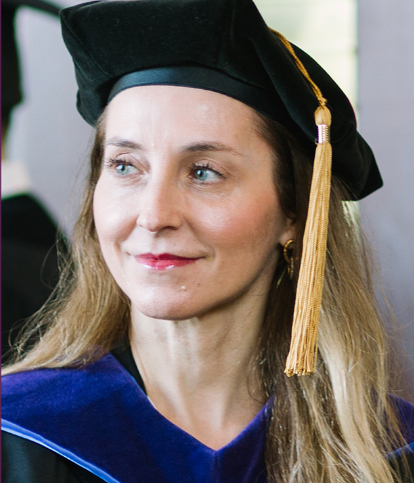
Marjorie Schwarzer, Department of Museum Studies
Ask Marjorie Schwarzer, professor and chair of JFKU's Department of Museum Studies, how she became interested in museums, and she'll tell you it started at age five, in the company of her parents and brother in Buffalo, New York. "We went to the Op Art show at the Albright Knox Museum. I vividly remember wandering through the space, looking up at huge canvases with psychedelic colors and shapes. Everything was gigantic, including the building, and it made a big impact on me. I still have a dog-eared souvenir postcard from that visit hanging in my office."
As a 1980s graduate student in nonprofit management at UC-Berkeley, Schwarzer attended a career fair, met a curator at what is now the Berkeley Art Museum who thought she would like working there, and began her museum career as an intern in its membership department. Eventually, she landed a position at San Francisco's Museum of Modern Art. When Schwarzer moved again, to Boston Children's Museum and then to the Chicago Children's Museum, she realized she could combine her interest in social equity and progressive education with her love of museums as special places. In 1996, she brought those interests to the JFKU Department of Museum Studies.
Ask Schwarzer today about her aspirations for museums, and she'll say: "I want museums to make me think in profound ways. I want museums to be more boisterous and to offer more moments for quiet contemplation. I want museums to value their staff, with concrete actions like more pay and benefits, and I want museums to value their publics, with simple gestures like more benches and clearer labels. In sum, I want museums to aspire to become kinder and more thoughtful places, beacons for society and the planet."
Schwarzer believes that the museum studies discipline and JFK University are dynamic communities that benefit each other. "Our track record—well over 30 years—of visionary thinking, professionalism, and academic excellence at JFKU, combined with our commitment to social equity and civic engagement, makes our museum studies program one of the oldest and most respected in the United States."
Since arriving at JFKU, Schwarzer's dedication to educating the next generation of museum professionals has included teaching, research, publications, presentations, and service with national associations, boards, and professional journals. Her latest book,
Riches, Radicals and Rivals: 100 Years of Museums in America, was published in 2006 by the American Association of Museums in celebration of its 100th anniversary and was the basis for a nationally broadcast public television program.
Schwarzer holds an MBA from the University of California, Berkeley, and a BA in art history from Washington University in St. Louis. In addition to holding leadership positions at museums in Chicago and Boston, she has coordinated large-scale exhibit projects for Chicago's Museum of Science and Industry and the MIT Museum in Cambridge, Massachusetts. In 2003, Schwarzer received the Harry Morrison Award for Distinguished Teaching from John F. Kennedy University.
Kymberly Smith, School of Law
From her nearly ten years as a federal prosecutor—first in St. Louis (MO), then in Sacramento (CA)—Kymberly Smith has a wide range of interesting and useful experience to call on when teaching classes in Legal Research and Writing and Criminal Law at JFKU's School of Law. As an assistant U.S. attorney (AUSA), Smith handled cases dealing with everything from firearms to drugs to white-collar crime. She executed hundreds of search warrants and wiretaps and actively prosecuted cases, taking them through trial and appellate courts, including the federal courts in the 8th Circuit and the 9th Circuit. So what brought her to JFKU?
"I've been a practicing attorney since 1992, but I love teaching," says Smith. "I always knew I would move toward education after a period of legal practice. I know I can make an impact by sharing what I learned firsthand about the power and value of the law."
During law school, Smith clerked for a judge who had been a federal prosecutor; she was impressed by the judge's command of the law. "Public service appeals to me, and by practicing at the federal level—with access to incredible resources and institutional knowledge in a quality court system with good people—I gained valuable and substantive legal experience. Now, I'm determined to 'pay it forward,' to share that wisdom with others who also want to serve the public in a variety of ways."
Service, indeed. Smith not only teaches in the School of Law, she's enrolled in the PsyD linked degree program, noting that there are many ways her professional education in psychology complements her legal background. "The legal system is only as good as the people within it," says Smith. "It's important for officers of the court to appreciate cause and effect, to understand power and how their practice as attorneys shapes the law. We must be aware of how that reflects who we are as a society. As attorneys, we have a serious responsibility to apply the law appropriately and learn how to ethically deal with the power we hold."
Smith values the practical experience of her faculty colleagues: they bring the law alive in real-world terms. "In addition to our exceptional core faculty, JFKU is committed to attracting scholar-practitioners from many specialties and backgrounds. Everyone is intent on providing a quality education to our students."
The mission and diversity of JFKU matches Smith's priorities. "I wanted to be part of a place that respects diversity and where I can also believe in its mission. That's what I found in JFKU's comfortable, genuine environment. Our faculty and administration are open, accessible, receptive, and willing to communicate. We also offer flexible schedules that make it possible for busy professionals—including me!—to continue their education with outstanding results."
Charles F. 'Chuck' Piazza, School of Management
"Sustainability has become the latest business buzzword," says Charles F. 'Chuck' Piazza, Ph.D., associate professor in the School of Management. "But sustainability and social responsibility are management concepts that have been part of the JFKU experience for a long time. And they dovetail nicely with my professional focus on how information systems affect conditions and relationships within organizations and teams. As more of us work in the virtual world, collaborating in cyberspace as well as face-to-face, we need to look deeply at the human and ethical impact of technology."
Piazza is not anti-technology. Rather, he strives to create a management and organizational communication model where technology benefits the organization, the workforce, and society. Before finding JFKU in 2005, Piazza served as Associate Program Director for Information Systems at USF. He also taught across disciplines in departments as diverse as psychology, organizational behavior, public administration, and liberal arts, and served as adjunct faculty at institutions such as Dominican College and St. Mary's College of California. At JFKU, Piazza specializes in virtual networking practices and works primarily with MBA students as they examine emerging business models, visionary leadership styles, and transformative change methods. In the School's Program Management specialization, he focuses on organizational communication and dispersed teams, teaches online, and is developing a new class format that uses 'wiki' platforms as a collaborative learning tool.
JFKU's awareness of social responsibility and sustainability resonates with Piazza. Its smaller size and supportive atmosphere fuels creativity and innovation. And its holistic perspective, collaborative colleagues, and transformative learning atmosphere are vital to his professional goals.
"This is a resourceful place," says Piazza. "JFKU's committed core faculty and extensive roster of scholar-practitioners in the School of Management offer personal, one-on-one attention. Within our rigorous academic program, you're expected to think on your own and take advantage of our significant coaching and mentoring opportunities. Ours is a challenging, relevant, and adaptable graduate education that will carry you into the future. You'll hone your skills in critical thinking and innovative problem solving under the attention of caring faculty who are intent on finding realistic, socially responsible ways to transform the workplaces of today and tomorrow, always considering the human impact of technology and conducting business."
Piazza values the opportunities JFKU affords him to get to know, challenge, and mentor students. "I enjoy helping people develop personally and academically as they seek to understand their professional dreams and stretch beyond their current skill levels. Our students are working professionals, so when they bring real-world situations into the classroom, we see immediate impact. Our holistic approach to education fosters critical examination of complex organizational systems and cultures, envisions sustainable forms of strategic management, values diversity, and promotes global workplace practices rooted in work-life balance. Our learning community nurtures professional ethics, creating leaders who stimulate organizational innovation with integrity. These are current and future issues, and JFKU is a great place to explore their dynamics in ways that authentically make a difference."
Sandra Mattar, Graduate School of Professional Psychology
"Today's professional psychologists—and those who will practice in the future—face a highly connected and multicultural world," says Sandra Mattar, Ph.D., associate professor in JFKU's Doctor of Psychology program. "With demographics shifting around the globe, we need to appreciate and value that diversity. Our role as mental health professionals is to help people adapt to rapid change and interaction with populations whose cultural experiences differ from our own. We must explore what's real, what's happened in the past, and what barriers about 'others' we may have internalized."
A native of Caracas, Venezuela, Dr. Mattar exemplifies the diversity of JFKU's outstanding faculty scholar-practitioners, which includes people of many ethnicities, backgrounds, cultures, and abilities. Dr. Mattar and her husband came to the United States in 1988 for graduate schooling in Boston, where she achieved her PsyD at the Massachusetts School for Professional Psychology. When UC-Berkeley offered her husband a teaching position in 1994, they moved to the West Coast.
In the Bay Area, Dr. Mattar began teaching about multicultural issues and met Rhonda James, who asked her to join JFKU, where GSPP's doctor of psychology program recruited her. "This program is built on the same foundational issues that are important to me. We think alike! JFKU's small classes, available peer groups, and accessible faculty create a close-knit, family feeling," says Dr. Mattar.
At JFKU, Dr. Mattar investigates and teaches about directions the profession of psychology in the U.S. should take, including deep exploration of ingrained biases and prejudices within the person and the profession. Collaborating with her JFKU colleagues, she helps provide a transformational environment for training culturally sensitive psychologists to practice as instruments of change around issues of social justice.
"In our program, you must be willing to look at yourself and address issues that society may not be ready to face directly," says Dr. Mattar. "You must be open to considering others' points of view and be willing to have authentic conversations about serious, sometimes painful, subjects—and, of course, be open to joyful experiences as well!"
"We're on the leading edge of awareness surrounding multicultural issues," says Dr. Mattar. "When we attend professional conferences, we find current topics focus on subjects that have been an integral part of JFKU's program for years. We don't add diversity as an afterthought; we build it into every aspect of the curriculum and live it every day."
As the world becomes a more fearful place, Dr. Mattar's focus has expanded to include issues of trauma and resilience and culture and trauma. Currently, Dr. Mattar serves as membership chair of the Trauma Psychology Division (Division 56) of the American Psychological Association.
"I was born in Venezuela, my parents are from Lebanon, and I grew up speaking four languages," says Dr. Mattar. "While my kids tease that it's confusing, I'm a living example of the 21st century global population our profession must be ready to serve."
Vernice Solimar, PhD, School of Holistic Studies
“I heard the call of the university in a profound way,” says Vernice Solimar, PhD, professor of Integral Studies in the School of Holistic Studies. “It felt like discovering my life’s true vocation. Even beyond the universal values of academic integrity, rigor, and scholarship, JFKU addresses human issues with a compassionate, student-centered approach. Students who choose to study with us are mature, life-oriented, service-directed adults, committed to education and to making a positive difference in the world.”
Solimar, whose family is from Puerto Rico, came to JFKU by way of New York City, where she was a public school teacher. After achieving an MA in counseling psychology, Solimar went on a 40-day meditation retreat and met someone familiar with JFKU who talked to her about the Consciousness Studies MA program and its focus on psychology, spirituality, and consciousness. “Contemplating how those three disciplines could work in harmony touched me deeply, and I knew I wanted to learn more about the school.”
In 1982, Dr. Solimar attended several courses at JFKU and received her PhD in East-West Integral Psychology from The California Institute of Integral Studies (CIIS) in San Francisco. Upon graduation in 1986, she became adjunct faculty at JFKU, teaching courses that included
World Religions, Holistic Education, and
Metaphors and Symbols of Transformation. She has also taught at the Graduate Theological Union in Berkeley and at the California Institute of Integral Studies. In 1989, Solimar became a full-time JFKU faculty member and chair of the MA program in Consciousness Studies. She is presently chair of the Integral Studies Department, responsible for four master’s programs and two certificates. In this position, she has also taught courses in
Integral and Transpersonal Psychology, Paradigms of Consciousness, and
Consciousness and Social Issues, among others.
“Our curriculum integrates several academic fields: science, psychology, spirituality, philosophy and health,” says Dr. Solimar. “We emphasize perspectives in these disciplines that foster a transformation of consciousness and new ways of being in the world. Through the study of holistic and integral principles of personal growth and deep self-inquiry, students experience themselves in more complete ways as agents of intentional change. Along with academic theory and experiential practices, programs in the School of Holistic Studies incorporate the sacredness of the body and the earth. This sense of our embodied soul-in-the-world is crucial to our holistic orientation. This integrated approach engenders the wholeness of human development.”
Early in 2007, Professor Solimar went to Puerto Rico on a sabbatical. During that time, she researched cultural and philosophical aspects of Puerto Rican social activism and helped establish a core group interested in exploration of an integral view of social activism.
In the Fall of 2007, Solimar will accompany a core faculty member from the Integral Psychology MA program and students from JFKU to El Salvador. This integral fieldwork will focus on individual, community, and environmental well-being in a global context. The field course will encourage integral applications for community development and greater cultural awareness.
Dr. Solimar is also engaged in dialogue with a group of educators proposing “Integral Africa,” a vision that seeks to create integral education for future leaders of the African continent.
“Many students come into our programs because they’re looking for an authentic way to serve the world,” says Solimar. “We challenge them to inquire deeply into their ways of thinking and perceiving, to find out what is essentially true for them, and apply classroom theories to their personal and professional life. The outcome is a new capacity, a new understanding, and a new inspiration for experiencing the world as a profound blessing. As students continue to awaken their wisdom and compassion, their lives are transformed. I am always deeply inspired by the quality of students who come to us, by the work that they do with us, and by what they take back to the world when they graduate.”
Office of Enrollment Services
(800) 696-5358